Abortion is not equivalent to other social issues of our century.
It's not comparable to poverty, not comparable to gun violence, not comparable to GMOs, not comparable to vaccination, not comparable to energy crises, not comparable to environmental issues, not comparable to taxation, not comparable even to racism or sex trafficking. It's in a category of its own. That's a pretty big claim, I know, but it's only a sort of social illusion, a kind of stupor of dehumanization that makes it necessary to say.
Why is it not equivalent? Because abortion is:
1.) Killing an innocent human being. (There's a one-word summary for that: murder.)
2.) Legal. (It's publicly instituted, approved, protected, and supported.)
Abortion doesn't sometimes result in murders, or possibly result in murders, or arguably result in murders, it's murder by definition and intentional, institutionalized, public, legal & protected murder.
You can make arguments over all the other social issues, attempting to show that they exist, that they have deleterious effects to the extreme of - at worst - murder, but of the ones that involve or amount to murder, they are not legal, and the ones that are legal are not directly murder.
I could add a third to this, which is a matter of scale.
Abortion is not a small thing, something that happens in a corner, here or there, some atrocity happening in dark corners of society. In 2014, the year of the "historic low" in legal killings of innocent male and female human beings, 926,200 victims' bodies were sent to incinerators or to laboratories for experimentation.
( https://www.guttmacher.org/fact-sheet/induced-abortion-united-states )
Oddly enough even many who claim to be "pro-life" (presumably because they believe it to be murder - I can't think of any other sane reason to oppose it) think this is a sort of "victory" where only 926,200 human beings who belong to a dehumanized class are murdered with the full approval of the state and of a sizable and powerful majority. Put any other class of human beings that haven't been effectively dehumanized in that statistic and try to think of it as a "victory". Still thinking of some other people group, try to think of anything short of its legal abolition & prosecution coupled with a general abhorrence for it by the nation's people as a victory.
It may be good news to a few, and bad news to many, but there is a God. He is just, and is no respecter of persons. Every child suctioned out, every little hand, foot and head dismembered, belongs to His creation, a human being in His image that has his attention, whom He identifies as your neighbor in need. It's a sobering thought that Jesus Christ will come again to judge us "according to what we have done" in such a case. Our laws reject these little ones, God's image and creation. Our people murder them with impunity in public institutions. The majority of our "righteous" defend them with halfhearted regulatory demands as something less than human, while even more don't raise their voice at all in protest for fear that their popularity might take a hit.
Abortion is a holocaust, an antebellum slavery-style abomination, a genocidal massacre, and a present reality. It is not the only evil that needs righting in our world, but it is our national sin, with a prominence greater than any other. To speak otherwise is to speak untruly.

Sunday, May 19, 2019

Monday, October 03, 2016
#2
NUM 19 - the Red Heifer for the "water for impurity"
Of course I think of Jesus, with the same sacrifice (connected by blood to the tent of meeting) used over and over to cleanse subsequent uncleannesses. He was offered only once, yet we are still cleansed by nothing else.
V.10 is a theme repeated over and over in the Law, that there's "One statute both for the people of Israel & those who sojourn with them." Outsiders didn't get to say "I don't believe in that stuff, count me out". If anyone's living with us, we shouldn't allow them to live however they please in our communities, there is one way to live if you're living with us, whether or not you "believe in it".
We know that a man doesn't get unclean from what's outside, but as Jesus said from the things that come from the heart. As Christians we still become unclean in that way, and still need to cleanse ourselves and one another. V.21 says the one who applies the water of cleansing to the unclean person made me think of Galatians 6:1 where we're told to restore one another gently looking out so we aren't tempted ourselves. The last few verses remind me of Jude 23, how dicey a work it seems to be to rescue a brother or sister in sin.
PS 57
V.9 stood out, as one more reason to sing. Singing is a constant Judeo/Christian practice throughout history, more than in any other "religion", & David says he does it in the midst of the unbelieving nations because God's faithfulness and love for him lasts beyond Gentile lands, even to the atmosphere and outer space.
DAN 12
The prophecy of the end proper, Daniel is told that at the time of great trouble "Your people shall be delivered" - I'm friends with a lot of Postmillennialist believers, who take most passages like this to refer to A.D. 70, yet this is decidedly NOT talking about the destruction of all Jerusalem and the diaspora/persecution of all Jews!, even if you factor in "everyone whose name is found written in the book". In Vs.7 again, the "shattering of the power of the Holy people" must come to an end.
V.10 speaks (reminiscent of Num19) of those who "purify themselves" for the time of the end. As John said in his first letter, "He who has this hope in him purifies himself as He is pure"
1 Thess 4
The will of God is our sanctification, called (V7) not for impurity, but in holiness that's concerned with what we do bodily (V4) & for the holiness of all our brothers/sisters as well; not to transgress or lead one another into uncleanness, but to encourage with knowledge of the Lord's coming, and increase of brotherly love one another. This seems to be the biggest recurrent theme in all my readings today.
Of course I think of Jesus, with the same sacrifice (connected by blood to the tent of meeting) used over and over to cleanse subsequent uncleannesses. He was offered only once, yet we are still cleansed by nothing else.
V.10 is a theme repeated over and over in the Law, that there's "One statute both for the people of Israel & those who sojourn with them." Outsiders didn't get to say "I don't believe in that stuff, count me out". If anyone's living with us, we shouldn't allow them to live however they please in our communities, there is one way to live if you're living with us, whether or not you "believe in it".
We know that a man doesn't get unclean from what's outside, but as Jesus said from the things that come from the heart. As Christians we still become unclean in that way, and still need to cleanse ourselves and one another. V.21 says the one who applies the water of cleansing to the unclean person made me think of Galatians 6:1 where we're told to restore one another gently looking out so we aren't tempted ourselves. The last few verses remind me of Jude 23, how dicey a work it seems to be to rescue a brother or sister in sin.
PS 57
V.9 stood out, as one more reason to sing. Singing is a constant Judeo/Christian practice throughout history, more than in any other "religion", & David says he does it in the midst of the unbelieving nations because God's faithfulness and love for him lasts beyond Gentile lands, even to the atmosphere and outer space.
DAN 12
The prophecy of the end proper, Daniel is told that at the time of great trouble "Your people shall be delivered" - I'm friends with a lot of Postmillennialist believers, who take most passages like this to refer to A.D. 70, yet this is decidedly NOT talking about the destruction of all Jerusalem and the diaspora/persecution of all Jews!, even if you factor in "everyone whose name is found written in the book". In Vs.7 again, the "shattering of the power of the Holy people" must come to an end.
V.10 speaks (reminiscent of Num19) of those who "purify themselves" for the time of the end. As John said in his first letter, "He who has this hope in him purifies himself as He is pure"
1 Thess 4
The will of God is our sanctification, called (V7) not for impurity, but in holiness that's concerned with what we do bodily (V4) & for the holiness of all our brothers/sisters as well; not to transgress or lead one another into uncleanness, but to encourage with knowledge of the Lord's coming, and increase of brotherly love one another. This seems to be the biggest recurrent theme in all my readings today.
Tuesday, September 06, 2016
#1
Num. 10
YHWH told Moses to make two silver trumpets, and then gives them all kinds of instructions on when and how to use them as a signal-system for moving the congregation (one long blast for gathering an assembly, an "alarm blast" to ready for war maneuvers, with details on who moves with what kind of blast). Reminders here of Paul's review in his first letter to Corinth (ch14) of proper use of glossolalia and prophecy:
"Again, if the trumpet sounds a muffled call, who will prepare for battle? So it is with you. Unless you speak intelligible words with your tongue, how will anyone know what you are saying? You will just be speaking into the air..."
Do the prophets and teachers and singers in the Church fulfill the same function of guiding God's people on earth in their "maneuvers" to advance His kingdom here?
Interesting to me is that God told them these trumpets were supposed to be "A perpetual statute throughout your generations". That means in constant use, as long as there are Jews around. Of course that's not been the case in practice (as with lots of other things that were said to be "perpetual statutes" e.g. God's name YHWH and the 7th day Sabbath), but I remember seeing a relief on the "Arch of Titus" (made in honor of the sack of Jerusalem in AD 70) among the temple goods being pillaged by Roman soldiers were two long trumpets. Also, Ethiopian christians in Axum (the ones who claim to have the Ark of the Covenant) have in the same church two ancient silver trumpets, wrapped in cloth. They say these were brought down (with the ark) during the times of the Kings of Israel to protect them from invaders. So perhaps these trumpets still exist somewhere, though not in use.
But even during the OT times, the trumpets couldn't always be used to gather the whole congregation, since once they entered the land they were spread out over 8,000+ miles. But they were to be "A perpetual statute". We see similar things with the Tabernacle, which slowly fades out of use (or morphs into a solid and stationary structure) as the Temple becomes the dwelling of the Ark and the location of corporate worship. So God's ordinances, though perhaps not functioning in the exact same way as when first instituted, are still legitimate for whatever ordained uses they still fulfill.
Lots of neat names in this chapter, including "Gamaliel" (name-ancestor of Paul's yeshiva teacher?).
Then there is Moses' recorded words for the going out of the Ark, which David repeats in the 68th Psalm: "Arise O LORD, & let your enemies be scattered". King David must have been literate, and probably copied out the books of Moses for himself (as God commanded in those books for kings to do.) In thinking over this chapter, David was inspired to make a Psalm about it, including the phrase "Sinai is now in the Sanctuary", speaking about God's developing of the ancient ordinances - Sinai, the Mountain of God, has now somehow been spiritually relocated to Zion in Jerusalem. There's also a Messianic prophecy there, talking about the Temple of Christ's body, resurrected, rising from the dead and ascending with "captives in His train".
Then there's the Ark setting out three day's journey in advance of the rest of the congregation to find a good camping spot for the people, but we also read that Moses asked Hobab (his desert dwelling Midianite brother in law) to act as a desert scout for them. Even in the midst of the supernatural guidance and demonstration of God's presence and power, there was room for normal means, a local scout to find a good spot. Hobab probably went with the ark to find a camp for them.
PS 46
It's not by David, but by a committee (the Sons of Korah)
They open with a description of circumstances that sound a lot like the great flood that destroyed the earth (of which most nations have ancestral memory - many Native tribes do, including my own, India did, Greece did.), but preface it all saying that "Hey, even when things look like that, WE won't be afraid.
I think of apocalyptic movies, with asteroids hitting the earth, or giant volcanoes/tsunamis destroying the better part of it, or even "2012" complete with global flood/ark. Crowds of people screaming and running. My daughter used to be terrified of those scenes, I know I was as a kid.
Now of course this statement of fearlessness is silly if we expect in times like those (heck, even normal disease and aging!) to be passed over as we "hide in God". But we do not fear death, as people who have hidden in the ever-present God, who even if our mortal body is destroyed (see Paul's second letter to the Corinthians, chapter 5) has prepared an eternal one for us in the heavens, and will remake the whole universe for us to live in.
When do the psalmists say we'll get that help, that "regeneration of all things"? See vs. 5. As one who has children in the grave, I know that the morning hasn't dawned yet, and wait for it eagerly.
It's that judgment and remaking that the Psalmists speak about in vss 4-11, the destruction of rebellious nations, making an end of all war, the final exaltation of God's kingdom on earth, including the city of God on earth, with the river of the water of life (see the beginning of the last chapter in the Bible) coming from its center.
So we're without fear through all troubles and disasters here, knowing that we're in the hands of an ever present God, confident that He will preserve us though we die, and waiting until "morning dawns".
DAN 3
This is the exception to Romans 13:1. When the world-spirit commands to worship, we are commanded to be silent.
In fact, though Hananiah, Mishael, and Azariah are told they'll be tossed into a furnace to have their skin melted off (People can be pretty severely burned before the heat goes far enough into the body to kill them, it's got to be a nasty way to go) if they don't violate YHWH's second commandment, they answer as men who know the truth of the Psalm above. "Our God whom we serve is able to deliver us...but if not...we will not serve your gods."
This is like the state of Christians at the present. The whole world has been commanded by the world spirit and his puppet governors to break the commands of God or face the consequences: to shut up about abortion, to approve sexual perversion, to agree with atheistic ideas about the universe's origin. We may all resist and refuse to comply in our own small ways, it's only a matter of time until "certain Chaldeans [come] forward and maliciously accuse [the Christians]" (vs.8)
Maybe God will yet astonish and convince even the present wicked rulers of His majesty and power when non-compliant believers hold fast and are rescued, remembering the ever-present God and our hope of resurrection. I hope & pray that this is such a time.
COL 2
Paul is showing here what he says about himself in 2 Cor 11:28 "Besides everything else, I face daily the pressure of my concern for all the churches". Here he's upset because people he knows are getting distracted and derailed from real Christian faith and practice by two roads connected to (but veering off from) the clear truth: circumcision and philosophy.
On the one hand, human philosophy, with human presuppositions and starting points, has lots to commend it: plausible arguments, the name of wisdom, knowledge, revealing mysteries of the Universe. We go to college for such things. We are shocked into silence and contemplation by "deep" movies and stories. They can be good so far as they go, many have bits of the truth in them and have paths that run for a few miles in the Way before they diverge. But they do, all of them, diverge. There is only one source of Truth, one great revealer of the Universe (and its Maker!) The eternal Logos, through which the universe was made and by which it is held in existence, who became flesh as and embryo->baby->man and walked around Israel for 30+ years teaching and healing before being killed and rising, who now sits at the right hand of the Father.
Jesus, who Paul's always on about.
On the other hand, human circumcision, an ancient practice, commended as an eternal statute in the Writings, the sign of God's chosen people distinguishing them from the nations as keepers of the Law of God through Moses, and with it all manner of customs and dietary habits that set people apart from those around them, that take a lifetime to master. There are many whose faith is derailed by special practices, (most of them inferior to circumcision!) that set them apart as the true keepers - special diets, outward signs, liturgical practices, all of which may have been useful and practical to turn men's minds to their sins and the necessity of having them removed to be separate and special to God. But all these signs are eventually made into something they are not. They cannot remove sin. They cannot purify the heart, they cannot defeat the evil spirits that would be our masters. But there is one who can do all these things, who DID all these things with a better circumcision of heart, with a real separation from the surrounding world by dying in Him to it and raising with Him from death - real Life, real difference:
Jesus, who Paul's always on about.
YHWH told Moses to make two silver trumpets, and then gives them all kinds of instructions on when and how to use them as a signal-system for moving the congregation (one long blast for gathering an assembly, an "alarm blast" to ready for war maneuvers, with details on who moves with what kind of blast). Reminders here of Paul's review in his first letter to Corinth (ch14) of proper use of glossolalia and prophecy:
"Again, if the trumpet sounds a muffled call, who will prepare for battle? So it is with you. Unless you speak intelligible words with your tongue, how will anyone know what you are saying? You will just be speaking into the air..."
Do the prophets and teachers and singers in the Church fulfill the same function of guiding God's people on earth in their "maneuvers" to advance His kingdom here?
Interesting to me is that God told them these trumpets were supposed to be "A perpetual statute throughout your generations". That means in constant use, as long as there are Jews around. Of course that's not been the case in practice (as with lots of other things that were said to be "perpetual statutes" e.g. God's name YHWH and the 7th day Sabbath), but I remember seeing a relief on the "Arch of Titus" (made in honor of the sack of Jerusalem in AD 70) among the temple goods being pillaged by Roman soldiers were two long trumpets. Also, Ethiopian christians in Axum (the ones who claim to have the Ark of the Covenant) have in the same church two ancient silver trumpets, wrapped in cloth. They say these were brought down (with the ark) during the times of the Kings of Israel to protect them from invaders. So perhaps these trumpets still exist somewhere, though not in use.
But even during the OT times, the trumpets couldn't always be used to gather the whole congregation, since once they entered the land they were spread out over 8,000+ miles. But they were to be "A perpetual statute". We see similar things with the Tabernacle, which slowly fades out of use (or morphs into a solid and stationary structure) as the Temple becomes the dwelling of the Ark and the location of corporate worship. So God's ordinances, though perhaps not functioning in the exact same way as when first instituted, are still legitimate for whatever ordained uses they still fulfill.
Lots of neat names in this chapter, including "Gamaliel" (name-ancestor of Paul's yeshiva teacher?).
Then there is Moses' recorded words for the going out of the Ark, which David repeats in the 68th Psalm: "Arise O LORD, & let your enemies be scattered". King David must have been literate, and probably copied out the books of Moses for himself (as God commanded in those books for kings to do.) In thinking over this chapter, David was inspired to make a Psalm about it, including the phrase "Sinai is now in the Sanctuary", speaking about God's developing of the ancient ordinances - Sinai, the Mountain of God, has now somehow been spiritually relocated to Zion in Jerusalem. There's also a Messianic prophecy there, talking about the Temple of Christ's body, resurrected, rising from the dead and ascending with "captives in His train".
Then there's the Ark setting out three day's journey in advance of the rest of the congregation to find a good camping spot for the people, but we also read that Moses asked Hobab (his desert dwelling Midianite brother in law) to act as a desert scout for them. Even in the midst of the supernatural guidance and demonstration of God's presence and power, there was room for normal means, a local scout to find a good spot. Hobab probably went with the ark to find a camp for them.
PS 46
It's not by David, but by a committee (the Sons of Korah)
They open with a description of circumstances that sound a lot like the great flood that destroyed the earth (of which most nations have ancestral memory - many Native tribes do, including my own, India did, Greece did.), but preface it all saying that "Hey, even when things look like that, WE won't be afraid.
I think of apocalyptic movies, with asteroids hitting the earth, or giant volcanoes/tsunamis destroying the better part of it, or even "2012" complete with global flood/ark. Crowds of people screaming and running. My daughter used to be terrified of those scenes, I know I was as a kid.
Now of course this statement of fearlessness is silly if we expect in times like those (heck, even normal disease and aging!) to be passed over as we "hide in God". But we do not fear death, as people who have hidden in the ever-present God, who even if our mortal body is destroyed (see Paul's second letter to the Corinthians, chapter 5) has prepared an eternal one for us in the heavens, and will remake the whole universe for us to live in.
When do the psalmists say we'll get that help, that "regeneration of all things"? See vs. 5. As one who has children in the grave, I know that the morning hasn't dawned yet, and wait for it eagerly.
It's that judgment and remaking that the Psalmists speak about in vss 4-11, the destruction of rebellious nations, making an end of all war, the final exaltation of God's kingdom on earth, including the city of God on earth, with the river of the water of life (see the beginning of the last chapter in the Bible) coming from its center.
So we're without fear through all troubles and disasters here, knowing that we're in the hands of an ever present God, confident that He will preserve us though we die, and waiting until "morning dawns".
DAN 3
This is the exception to Romans 13:1. When the world-spirit commands to worship, we are commanded to be silent.
In fact, though Hananiah, Mishael, and Azariah are told they'll be tossed into a furnace to have their skin melted off (People can be pretty severely burned before the heat goes far enough into the body to kill them, it's got to be a nasty way to go) if they don't violate YHWH's second commandment, they answer as men who know the truth of the Psalm above. "Our God whom we serve is able to deliver us...but if not...we will not serve your gods."
This is like the state of Christians at the present. The whole world has been commanded by the world spirit and his puppet governors to break the commands of God or face the consequences: to shut up about abortion, to approve sexual perversion, to agree with atheistic ideas about the universe's origin. We may all resist and refuse to comply in our own small ways, it's only a matter of time until "certain Chaldeans [come] forward and maliciously accuse [the Christians]" (vs.8)
Maybe God will yet astonish and convince even the present wicked rulers of His majesty and power when non-compliant believers hold fast and are rescued, remembering the ever-present God and our hope of resurrection. I hope & pray that this is such a time.
COL 2
Paul is showing here what he says about himself in 2 Cor 11:28 "Besides everything else, I face daily the pressure of my concern for all the churches". Here he's upset because people he knows are getting distracted and derailed from real Christian faith and practice by two roads connected to (but veering off from) the clear truth: circumcision and philosophy.
On the one hand, human philosophy, with human presuppositions and starting points, has lots to commend it: plausible arguments, the name of wisdom, knowledge, revealing mysteries of the Universe. We go to college for such things. We are shocked into silence and contemplation by "deep" movies and stories. They can be good so far as they go, many have bits of the truth in them and have paths that run for a few miles in the Way before they diverge. But they do, all of them, diverge. There is only one source of Truth, one great revealer of the Universe (and its Maker!) The eternal Logos, through which the universe was made and by which it is held in existence, who became flesh as and embryo->baby->man and walked around Israel for 30+ years teaching and healing before being killed and rising, who now sits at the right hand of the Father.
Jesus, who Paul's always on about.
On the other hand, human circumcision, an ancient practice, commended as an eternal statute in the Writings, the sign of God's chosen people distinguishing them from the nations as keepers of the Law of God through Moses, and with it all manner of customs and dietary habits that set people apart from those around them, that take a lifetime to master. There are many whose faith is derailed by special practices, (most of them inferior to circumcision!) that set them apart as the true keepers - special diets, outward signs, liturgical practices, all of which may have been useful and practical to turn men's minds to their sins and the necessity of having them removed to be separate and special to God. But all these signs are eventually made into something they are not. They cannot remove sin. They cannot purify the heart, they cannot defeat the evil spirits that would be our masters. But there is one who can do all these things, who DID all these things with a better circumcision of heart, with a real separation from the surrounding world by dying in Him to it and raising with Him from death - real Life, real difference:
Jesus, who Paul's always on about.
New Task?
I'm going to try something new, that should give me more consistent subject matter for this blog. Several years ago I read (I can't remember where) that Francis Schaeffer used to read four chapters of the bible a day, three from the Old Testament, and one from the New. Since that time I've adopted the same practice, and with God's help I've been able to keep it up 'til the present. I keep tabs in my bible that I move as I read, and write notes and observations and cross references as I go.
So what I'm hoping to do with some regularity is to put down some of my observations in this format. I hope this will serve two functions; to edify anyone who stumbles across them, and two, to give me a place other than a notebook (which I have the habit of losing) to record them.
So what I'm hoping to do with some regularity is to put down some of my observations in this format. I hope this will serve two functions; to edify anyone who stumbles across them, and two, to give me a place other than a notebook (which I have the habit of losing) to record them.
Sunday, August 30, 2015
Iesous
The answer to a question
seldom asked
but its shape is cast
into the festering
and groaning earth
dragged from the past
yard and mast
taint and curse
the broadcast ascends
from the mouth of dust
now ignorance must
make, and receive amends.
seldom asked
but its shape is cast
into the festering
and groaning earth
dragged from the past
yard and mast
taint and curse
the broadcast ascends
from the mouth of dust
now ignorance must
make, and receive amends.
Saturday, August 29, 2015
Unleaven'd
“...after so many thousands of people had gathered together that they were stepping on one another, He began saying to His disciples first of all,"Beware of the leaven of the Pharisees, which is hypocrisy.”"
The Lord warned his twelve against the leaven of the Pharisees. The disciples were concerned about the obvious failings, the practical mistakes they had made that were evident to all. But the Lord spoke about something else, something it took clarification to bring their attention to.
Hypocrisy.
Why tell them to “look out” for it unless there were danger - danger that it would take root in themselves? This is why he calls it “leaven”. It only takes a little, but once it finds its way into the dough, it will grow, and grow, until it has infected the whole.
Look out for it. We see men fall like trees in a forest full of loggers, and we think Oh God, look at the hypocrisy! The leaven has been discovered, once its work was done. Are the disciples of Christ immune? No! We have need to watch. Neither it is a harmless reality of the Kingdom, that hypocrisy is present in some. You might hear it spoken about in some circles when talking about the nature of the Church: “Yes, the church is full of hypocrites, there’s room for one more”. This does not address the leaven with the same wariness that the Lord commands. But what the Lord commands is not just to look out for this leaven in others, but in ourselves. There would be little point in watching if prevention were impossible.
I don’t say this because I’ve seen hypocrisy take root in other men. It is, like leaven, a silent, slow, steady worker. You don’t notice it, but your religion becomes less and less about communion with God and doing his will (concerning yourself with His Kingdom and Righteousness) and more and more becomes “I must do these things, so that people will know there is a godly man on the earth.” And all the while dark things grow in our private practice. Lies and inconsistencies grow when we are not in the light of public opinion and choke the life that once flowed from God to us in private. We say things we ought not say, we look at things we ought not look at, we meditate on things we ought not meditate on, and desires for dark things grow where there was once light. But there is nothing covered up that will not be revealed, and hidden that will not be known.
“Take heed” - Watch out for this! It is always there, the leaven is like pollen in the air, encapsulated in teachings that are mere human traditions, in a prideful attitude that is grateful it is not like other men, excusing its vices (evil thoughts--murder, adultery, sexual immorality, theft, false testimony, slander) while making sure to maintain the clean exterior, convincing themselves that it is for the glory of God that they must maintain appearances. In the Church in Corinth, it manifested among other things as a boastful concern for being of a prestigious party while allowing sexual immorality to flourish in their midst. In Peter it manifested as a refusal to eat with Gentiles.
Watch out, it is in the world still. If you see it growing in you, cut it off and throw it away. Your boasting is not good. Do you not know that a little leaven leavens the whole lump of dough? Clean out the old leaven so that you may be a new lump, just as you are in fact unleavened. For Christ our Passover also has been sacrificed. We are crucified to the world and it to us. It is no longer we who live but He who lives in us - provided He lives in us. Therefore let us celebrate the feast,
not with old leaven,
nor with the leaven of malice and wickedness,
but with the unleavened bread of sincerity and truth.
Thursday, August 27, 2015
"There will no longer be any sea"

it’s a dragon, leviathan flashing sacrificial fire
we know its hell-home, no bathymetry
is called for to crest and conquer
the swallower of souls
our ship is able
of Noachic build, and we
are a crew already drowned.
Impervious, we breathe a different air
so sail on, men and brothers, sisters fair
the shock of water-weight strikes down
on oiled brows - for we are christened as our keel and king
and will cut through this sea, that cartographic kenning
surely holds fast as friends, and it is written
we will cut the serpent wave, until the sea will be no more.
Tuesday, August 18, 2015
The Nature of Allegory
12:4:1 – The Nature of Allegory
 Reading through 2 Chronicles 4, one of the many details of the Temple’s construction stood out to me: the “sea”. It’s an odd sort of furnishing in the first place – tables, lampstands, those seem natural, but this huge chunk of bronze seems a little bit unusual. Then the numbers struck me. 12 bulls. Often 12 has something to do with the 12 tribes in the OT, so this made me pay attention. Then that they faced the four cardinal directions, something about the animals and the directions made me think of the book of revelation, angels holding back the four winds, oxen-faced cherubim, seas of glass around the throne – things like that. “One sea” (v.15) – it’s interesting to me that it’s numbered, not just “the sea” or “a sea”.
Long story short, I made an allegorical connection. The association occurred to me that the sea represents our “one baptism”. The oxen represent the twelve disciples/apostles of Christ, facing the four directions of the earth to bring it to all nations, from Jerusalem, as the Lord commanded.
I think I can defend this particular bit of allegory with Scripture, since we know from the NT that the elements of the house of God represent spiritual realities (Hebrews 9 comes immediately to mind). So it’s not a stretch to think that it means something more than a bunch of bronze cows (because ancient near-eastern people liked to decorate things with cows?) holding up a big bath for priests because, as we all know, cleanliness is next to godliness.
Even the “lily” shape of the rim lends itself to the allegory, since the Hebrew for lily (shushan) means “whiteness”, and the waters of baptism are to wash us white in the blood of the lamb. The sea was for the cleansing of the priests, and we are to be a kingdom of priests to our God. I found lots of little things that commended themselves to me as coherent symbols.
But then, that’s the problem with allegory; how do you prove beyond a doubt that your picture is right? Some symbolic connections in the OT that wouldn’t jump out at most of us are revealed as allegory by the inspired writers – the story of Hagar/Ishmael Sarah/Isaac being the most obvious (Gal 4:24). Yet for the great mass of OT symbolism there’s no explicit NT exposition. I’ve heard it suggested that we shouldn’t even try to find allegories beyond those the NT writers reveal. I don’t buy that, since the section of Hebrews I appeal to above indicates that there is lots of untapped symbolism there, and the Scriptures were given us for edification and study. But the question remains, how do you know you’re not just finding similarities that are incidental but unintended? And what about details that remain puzzling, like the cast mass of gourds around the sea? I have a hard time thinking of a spiritual significance for gourds. I mean, a valid one; it’s easy enough to conjure up connections off the cuff: “gourds are used to hold water, thence they are symbolic for the baptized bringing the water of life to the nations” there, I just made that up. But it’s not very satisfying. I don’t know how much if at all gourds were used to carry water in the ANE (ancient Near East), and the cast gourds aren’t spoken of as being meant to carry water. There’s more to a valid allegory than finding connections.
So, I acknowledge there are reasons to doubt any given allegorical interpretation. Even one of the historical figures criticized for his allegorical bent, Augustine, acknowledges this. In his “City of God” (book 15, chapter 26) he details his Christological allegory of the ark, but then acknowledges it may not satisfy all and opens up the field for others to make one better. He gives some alternate explanations he’s heard from others, and staunchly maintains that all those details weren’t put in there for nothing. This is the word of God meant for us. Sure it’s history, but it must mean something beyond just being a big boat to rescue folks from the flood. Something for us. Something about Christ. So figure out some allegory, and as long as it’s not ridiculous and fits with the central truths of the Christian faith, then more power to you. It may not even be correct, it may give way to a better one, but at least it’ll be edifying.
Not to say that all interpretations are equally valid, not at all. Just as in science, there can be multiple hypotheses that account for the data, and they must be judged by how well they account for it. Yet the impulse to discover spiritual meanings to OT details is not, I think, a bad impulse. If there is an intended symbolism in the detailed descriptions of the Scriptures (and it seems very plain that there is) we shouldn’t shy from attempting to make something of it. Not all symbols are equally difficult, some seem to me to be nigh undeniable (the “scapegoat” for instance). Some we’ll have to work harder for. And when we find one that strikes us as valid, we may have to hold to it with an open hand as Augustine advised. But we shouldn’t abandon the quest just because it involves uncertainty.
In a practical age, it will probably be asked “what good are allegories?” To which I respond by asking you to meditate on a line from the hymn “This is my Father’s World”:
“This is my father’s world, He shines in all that’s fair, in the rustling grass I can hear him pass, he speaks to me everywhere”
If God can speak to us and reveal his beauty and presence in wind blowing through the grass, in the details of creation, how is it so remarkable that he would do the same in the pages of the writings handed down to us from the patriarchs, prophets, and apostles as the word of God?
“This is my father’s world, He shines in all that’s fair, in the rustling grass I can hear him pass, he speaks to me everywhere”
If God can speak to us and reveal his beauty and presence in wind blowing through the grass, in the details of creation, how is it so remarkable that he would do the same in the pages of the writings handed down to us from the patriarchs, prophets, and apostles as the word of God?
So there you have it. Four directions, one baptism, 12 bulls to bear the message of cleansing and rebirth. “Go ye therefore, and make disciples of all the nations, baptizing them into the name of the Father and of the Son and of the Holy Spirit.” The global purposes of God and the mission of his servants. If nothing else, I hope that next time you read through Chronicles, those realities come to mind.
Saturday, May 23, 2015
May18
A world died today,
the bones of the universe
are out of joint, and the day
of its healing remains unseen.
Yet who hopes for what he already has?
There will be a restoration of all things,
when He comes who made Pleiades
and formed Orion.
the bones of the universe
are out of joint, and the day
of its healing remains unseen.
Yet who hopes for what he already has?
There will be a restoration of all things,
when He comes who made Pleiades
and formed Orion.
Friday, April 24, 2015
One way valve - installed the wrong way.
A strange bit of reasoning I've seen pop up several times in reference to different popular vices. The most recent of which was part of a conversation where some Christians were urging others to be part of homosexual 'weddings', but I've seen it used in other disputes as well. Here it is:
“Well, we don’t confront [some established sin] when it
occurs in the Church, so it would be hypocritical to confront [the sin
currently being pressed on the Church]”.
In the particular conversation I mentioned above, the argument was "since Christians don't distance themselves from remarriage weddings (which Jesus said -w/possible qualifiers- are adultery), they should not refuse to be part of homosexual 'weddings'."
In the particular conversation I mentioned above, the argument was "since Christians don't distance themselves from remarriage weddings (which Jesus said -w/possible qualifiers- are adultery), they should not refuse to be part of homosexual 'weddings'."
Don’t the people making the argument realize that such a policy is basically a one-way valve allowing all sin to be normalized into the Body of Christ, and for no sin to be expunged?
Doesn’t it make more sense to say that since Scripture speaks against both practices - the established sin and the one they’re lobbying to introduce - we should obey God and curtail *both* sins?
As difficult as it has been, I've intentionally not gone to several divorce-remarriage weddings of people I love because they had not had Scriptural justification for their divorces, and I am convinced from Scripture that it would be false to God and to them to affirm their remarriage with my presence.
Sunday, April 19, 2015
Mnemonics
My shoe box has filled up with days
a hill of pages, stacked in reams
while I on top
look back on youth
from traveled age.
The cord, I feel, is growing thin
the process has long since begun
when heaviness to soil consigned
gravely planted for a Son to find
my waiting breath then carried up
wrapped about with every page
remembered,
to wait through my long cold December
in that presence I have longed to see
with friends to wait for every spring
I once, so many years ago
was born with skin,
and will yet wake
a child - and a man,
with my children all around me.
a hill of pages, stacked in reams
while I on top
look back on youth
from traveled age.
The cord, I feel, is growing thin
the process has long since begun
when heaviness to soil consigned
gravely planted for a Son to find
my waiting breath then carried up
wrapped about with every page
remembered,
to wait through my long cold December
in that presence I have longed to see
with friends to wait for every spring
I once, so many years ago
was born with skin,
and will yet wake
a child - and a man,
with my children all around me.
Thursday, January 22, 2015
1 Sam 15
This is the story of how Saul lost the kingship of Israel.
I find it interesting how at the end Samuel announces to Saul that this "tearing away the kingdom" from him will without doubt happen because God is "not a man, that He should lie or repent". Yet, Samuel grieved over Saul, and it's noted that the LORD also repented that He had made Saul king.
So, The Lord doesn't repent, but He repented of making Saul king?
What if Saul had refused to believe that the LORD doesn't repent, and thought "Perhaps, if God can change his mind about me being king, then maybe - if I repent - he will change it back?"
Of course, Saul seems to have no real regard for the LORD, since during the account he constantly calls the LORD "your [Samuel's] God", and rather than even trying to repent (even if all to be gained from repentance were a restored personal relationship to the LORD) He gets Samuel to go through the motions so he can be honored before the elders of his people, but isn't exerting any energy to be honored by "Samuel's" God. Saul's attitude reminds me of a verse from Isaiah: "Stop regarding man, in whose nostrils is breath, for of what account is he?"
I find it interesting how at the end Samuel announces to Saul that this "tearing away the kingdom" from him will without doubt happen because God is "not a man, that He should lie or repent". Yet, Samuel grieved over Saul, and it's noted that the LORD also repented that He had made Saul king.
So, The Lord doesn't repent, but He repented of making Saul king?
What if Saul had refused to believe that the LORD doesn't repent, and thought "Perhaps, if God can change his mind about me being king, then maybe - if I repent - he will change it back?"
Of course, Saul seems to have no real regard for the LORD, since during the account he constantly calls the LORD "your [Samuel's] God", and rather than even trying to repent (even if all to be gained from repentance were a restored personal relationship to the LORD) He gets Samuel to go through the motions so he can be honored before the elders of his people, but isn't exerting any energy to be honored by "Samuel's" God. Saul's attitude reminds me of a verse from Isaiah: "Stop regarding man, in whose nostrils is breath, for of what account is he?"
Saturday, January 10, 2015
1 Peter 1:8
All best dreams find flesh and bone
as in your footprints they are sown
surge up like mountains from seeds of stone
who thought, to see you bleed & groan
was cursing coming all unwound?
The first day saw you break the ground
of newer earth, of fresher years
you rose up, casting off our fears
the Wind rushed out, He washed us clean
and made us who we'd never been
betrothed in water to worlds unseen
once caked with death, now scoured clean
with songs and strength to fight within
to face the night, and standing, win
bind up wounds, and cast down gods
with shining feet, prepared and shod
for every good work done through pain,
until we wake, with You again.
as in your footprints they are sown
surge up like mountains from seeds of stone
who thought, to see you bleed & groan
was cursing coming all unwound?
The first day saw you break the ground
of newer earth, of fresher years
you rose up, casting off our fears
the Wind rushed out, He washed us clean
and made us who we'd never been
betrothed in water to worlds unseen
once caked with death, now scoured clean
with songs and strength to fight within
to face the night, and standing, win
bind up wounds, and cast down gods
with shining feet, prepared and shod
for every good work done through pain,
until we wake, with You again.
Thursday, January 01, 2015
Mary New Year's Eve.
Old Year was more like four
-Since Eve brought in the dark;
Had all the world, but wanted more
And got trespassed from the park.
New Year is still going strong
Her Eve was full of belief;
She said “let it be”, and sang up a psalm
bringing fruit that would bear up our grief.
-Since Eve brought in the dark;
Had all the world, but wanted more
And got trespassed from the park.
New Year is still going strong
Her Eve was full of belief;
She said “let it be”, and sang up a psalm
bringing fruit that would bear up our grief.
 |
| (not my artwork) |
Tuesday, October 28, 2014
Death, death, death...will be undone.
This whole life and universe were a dead body of mine,
a scab to cover all my flesh and seal my breath
to get out, to pull it off me
but I had to walk in it until it rotted off instead.
My prayers had no power, they were a gun that wouldn't fire
those weapons mighty to pull down strongholds
were not mighty in my hand
I swung them, they cut only me.
the strongholds held
and the light fell.
I entered a new and older world
full of wrinkles, and the smell of age.
Every day a weary turning and every chapter a dim-lit dream
I saw color though, false color-
every time I woke up blind.
Every time the voice of the prior world
couldn't make it - wasn't loud enough
for time makes us all deaf
and does not heal,
but cauterizes.
But there is another world
and there is a living body
and there is a real daylight, real color,
and nothing good - no one small
is devoured when they are swallowed
we will see there
that every bullet found its mark
for it will,
this corpse it will,
rot away.
And behind it?
Behind it?
Lies the Day,
lies Himself.
a scab to cover all my flesh and seal my breath
to get out, to pull it off me
but I had to walk in it until it rotted off instead.
My prayers had no power, they were a gun that wouldn't fire
those weapons mighty to pull down strongholds
were not mighty in my hand
I swung them, they cut only me.
the strongholds held
and the light fell.
I entered a new and older world
full of wrinkles, and the smell of age.
Every day a weary turning and every chapter a dim-lit dream
I saw color though, false color-
every time I woke up blind.
Every time the voice of the prior world
couldn't make it - wasn't loud enough
for time makes us all deaf
and does not heal,
but cauterizes.
But there is another world
and there is a living body
and there is a real daylight, real color,
and nothing good - no one small
is devoured when they are swallowed
we will see there
that every bullet found its mark
for it will,
this corpse it will,
rot away.
And behind it?
Behind it?
Lies the Day,
lies Himself.
Friday, September 19, 2014
Tattoos, blood, and dubious appeals to context.
A while ago I went on a short rant about how often I see an unsupported appeal to "context" to explain away all sorts of uncomfortable scriptures. While cataloguing my books, I ran across an example I'd like to share with you. The author is dealing w/ Lev. 19:28:
 "If we study Leviticus in its context, we see that it isn't talking about tattoos in general, but tattoos that identify a person with a pagan deity or pagan practice. Two verses before, it forbids the eating of meat with blood in it. Does this mean you can't eat your steaks rare? Not at all. This is talking specifically about the meat that was offered as a sacrifice, not an evening out at Mortons..." (Kimmel, 'Grace Based Parenting', pp. 155,156)
Ok, so we have an appeal to context, and an absolute claim (unsupported in the book) that the prohibition unambiguously applies only to pagan tattoos. Then even more troubling, a similar unsupported appeal to context is used to say that the prohibition against eating blood applies only to sacrificial meats, which is a very, very dubious bit of exegesis! By the same token we could say vs. 29 means we can't sell our daughters into *pagan* prostitution, but regular prostitution is OK. Do a search for "eat, blood" on biblegateway and read how many vss. prohibit it strongly. Also, read Deut. 12:20-25 and ask yourself if that sounds like a general prohibition against eating blood or not. Read Lev. 17:14 and ask yourself if that seems like a rationale for the prohibition. And then look at Acts 15:20,29 and 21:25 and see that the prohibition carries into the NT, and if you feel inclined to say that there too it applies only to blood sacrificed to idols, then ask yourself why you don't say only the sexual immorality prohibited in the same verse only applies to that done in worship to idols.
All that so say, a well-supported understanding of the actual, demonstrated historical and textual context is very important to interpretation, but don't let writers sucker you with appeals to context that aren't carefully supported and especially when they ignore the whole testimony of Scripture. I'm sure we've all imbibed bucketloads of asides like this on our course of reading books and listening to sermons, and probably repeated them too, not without effect. My advice would be when someone is telling you the bible doesn't mean what it seems to be saying, don't take their word for it, even if they say the magical word "context", until you've verified that it indeed IS the context and that it doesn't go against the rest of the witness of the Scriptures.
Ok, so we have an appeal to context, and an absolute claim (unsupported in the book) that the prohibition unambiguously applies only to pagan tattoos. Then even more troubling, a similar unsupported appeal to context is used to say that the prohibition against eating blood applies only to sacrificial meats, which is a very, very dubious bit of exegesis! By the same token we could say vs. 29 means we can't sell our daughters into *pagan* prostitution, but regular prostitution is OK. Do a search for "eat, blood" on biblegateway and read how many vss. prohibit it strongly. Also, read Deut. 12:20-25 and ask yourself if that sounds like a general prohibition against eating blood or not. Read Lev. 17:14 and ask yourself if that seems like a rationale for the prohibition. And then look at Acts 15:20,29 and 21:25 and see that the prohibition carries into the NT, and if you feel inclined to say that there too it applies only to blood sacrificed to idols, then ask yourself why you don't say only the sexual immorality prohibited in the same verse only applies to that done in worship to idols.
All that so say, a well-supported understanding of the actual, demonstrated historical and textual context is very important to interpretation, but don't let writers sucker you with appeals to context that aren't carefully supported and especially when they ignore the whole testimony of Scripture. I'm sure we've all imbibed bucketloads of asides like this on our course of reading books and listening to sermons, and probably repeated them too, not without effect. My advice would be when someone is telling you the bible doesn't mean what it seems to be saying, don't take their word for it, even if they say the magical word "context", until you've verified that it indeed IS the context and that it doesn't go against the rest of the witness of the Scriptures.
The Risk of Obedience Vs. the Risk of Inaction
In
several conversations with friends about Abolition, it has come up that we are
at risk of “judging” and it is often pointed out what our Lord, his brother,
and his apostles said about judging others.
Now the proper understanding of what kind of judging the Lord was
warning against has been dealt with elsewhere, yet even with a proper
understanding of the sin of judging in mind, I’ve never brushed aside the concern
when my brothers and sisters have brought it up. I agree, it IS a risk.
Yet to live is to risk. In God’s appointed order time pushes us on, through crossroad after crossroad where we must take risks in order to obey, and when we reach the Celestial City, we will not be asked how studiously we avoided risks. This applies even to risks of sin. To avoid risk is not to avoid sin. In Galatians 6:1, Paul directs us to risk sin in order to help a brother. Every act of obedience carries with it a risk of sin. The risk is unavoidable, and we aren’t too busy ourselves avoiding it. We are to obey with open eyes, watching ourselves lest we be tempted.
Yet to live is to risk. In God’s appointed order time pushes us on, through crossroad after crossroad where we must take risks in order to obey, and when we reach the Celestial City, we will not be asked how studiously we avoided risks. This applies even to risks of sin. To avoid risk is not to avoid sin. In Galatians 6:1, Paul directs us to risk sin in order to help a brother. Every act of obedience carries with it a risk of sin. The risk is unavoidable, and we aren’t too busy ourselves avoiding it. We are to obey with open eyes, watching ourselves lest we be tempted.
If
we fear the Master, thinking Him a hard man, he will try us by our own words
and ask why we did not invest his gifts in the necessary risks, risking failure
to give him a return. There will be, he
has told us, those who come cringing out holding the gift returned, unrisked,
unprofitable. He may well say to them on
that day:
“I
gave you a task, I have you my Truth, my Spirit, my gifts, and you did not use
them to pray with your every action that my Father’s will would be done on
earth as in heaven; you did not use them to cry out against murder and mayhem,
to follow your master in driving out Beelzebub and destroying his works.”
Action, obedience, is risky. Our judgment is never guaranteed to be perfect – it is true that with crying out against murder and oppression comes the risk of sin, yet not to do this comes with risk as well! A great and terrible risk: to neglect the command to love our neighbor as ourselves, to fail to take into account the weightier matters of the law.
 There
is something further. I suspect that what prompts so many to point out the risk
taken by abolitionists is not a genuine fear of the possibility of unrighteous
judging. I am afraid that it might be
something less noble, less spiritual – that it might be the fear of man, the
fear of contradicting the spirit of the age and facing a dragon’s wrath. They know that the dragon only pursues those
who keep the commandments of God as well as the testimony of Jesus (Rev. 12:7),
and this makes them not very eager to keep those commands.
There
is something further. I suspect that what prompts so many to point out the risk
taken by abolitionists is not a genuine fear of the possibility of unrighteous
judging. I am afraid that it might be
something less noble, less spiritual – that it might be the fear of man, the
fear of contradicting the spirit of the age and facing a dragon’s wrath. They know that the dragon only pursues those
who keep the commandments of God as well as the testimony of Jesus (Rev. 12:7),
and this makes them not very eager to keep those commands. And what of those who risked, watching themselves to remain unstained yet always striving towards the upward call of God in Christ Jesus, keeping His word? “The one who conquers will have this heritage, and I will be his God and he will be my son.”
Tuesday, August 26, 2014
Beatitude #2
“Blessed
are they that mourn, for they shall be comforted.” – The Lord Jesus Christ
Some
interpret this as those who mourn over their sin, in keeping with the “blessed
are the poor in spirit” that comes just before it. Others affirm that it applies to those who
mourn in general, over the sorry condition of the world, death and
wickedness. But can’t it be both? Trace both of these back; the external evils
of the world around us, and the evil of indwelling sin. Both are good reasons
for mourning. Both have a common root in
a single event: “The tree of prohibition, root of all our woe.” And how can we be comforted? How is it possible to reverse something so
far upstream? To undo the transgression
that the whole creation -including we who have the first fruits of the Spirit-
have been mourning over? For that we
would need a new temptation – but this time overcome. We would need a new Adam, a new Eve for that
Adam, a Tree of Life, a New Heavens and Earth!
And that is what God has begun to do.
Well, we have the comfort of knowing we are forgiven, we have the
comfort of seeing present victories over indwelling sin through the Spirit, and
now and again we are comforted when God through His mercy heals physical ills
when we pray in Jesus’ name. But we
look for the day when the deal is done - when all causes for mourning, within
and without, are done away with. And
those who hope for just this (and rejoice in what measure they have presently
received it) wait for the full overturning that will bring them the comfort
that they mourn for. Only those who
hunger and thirst for the setting right of everything will be satisfied.
Friday, April 11, 2014
M25
Does fear pith our volition when
It feels like guesswork to begin
The land ahead was never mapped
The signal’s dead, and knowledge sapped
And you must forward, forward go
Build on fragments of the known
Does it feel unfair, and make you squirm
To be tested in what you’d never learned?
Our days are not a paper test
To judge our gleanings from a text
The eyes that see, the fire tries
The central stuff with this assize
Know: steadfast love is what’s desired
Producing poor from wealthy liars
Sheep and goats will both say “when”
As test results are coming in
On the rock, or on the sand?
The Storm assays the sons of man
Monday, September 09, 2013
A Comparison of Abortion to Slavery and Genocide.
Here's an article I published on Wordpress:
THE ABOLITIONIST: The Comparison of Abortion to Slavery

The comparison of abortion to slavery/genocide is usually dismissed for purely visceral reasons (are those really reasons?), so I thought it would be worthwhile to examine how the comparison is accurate and in which ways it may not be. Let’s begin with genocide.
Genocide is the systematic murder of a people group, and abortion belongs in this category inasmuch as there is a subgroup of human beings, those still in the womb, who have been dehumanized in order to justify their destruction. How is abortion unlike other genocides? Well, firstly the preborn aren’t part of a different ethnic group from their attackers, and secondly they have no means of resistance.
Next we come to slavery. With slavery the “owner” was free to choose whether or not a slave had value and would survive. Slaves were a commodity, and usually their lives weren’t ended unless the “owner” thought it would be more lucrative for the slave to die. Likewise, babies en route to birth are treated as items for the auction block. If unwanted, they are judged by society as having no value and are likely to be killed. If they are wanted, society decides to treat them as human beings after all and act accordingly.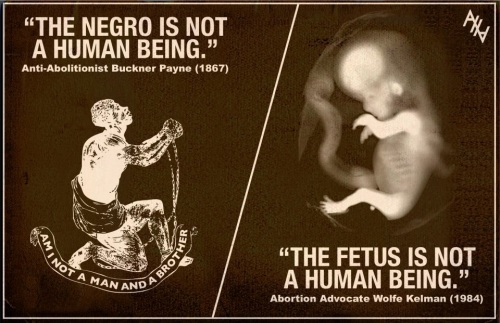

Is human worth based on nothing more concrete than a community’s estimation? Are you only what other people think you are? Do individual members of society alone determine the value of life? Is perception truly reality?
Thank God this isn’t so! There is a reality that exists and to which all perceptions must conform or be revealed as delusions. The author of reality is not you, or I, but the God who made us both and all else. You bear his image, the divine impression – however marred – and so does the human being now developing in her/his mother’s uterus.
To play at costs and benefits in deciding whether or not to kill such a being as you, I, or our counterpart in utero is no different than a slave owner deciding whether or not to sacrifice the lives of his human “property.” The mass-murder of the pre-born population accompanied by a campaign to dehumanize the victims and cover up the aftermath is no different than genocide. Allow your conscience to be informed by reason, and then let conscience dictate your actions. And if, like us, you accept the revelation that God made human beings in his image; welcome to Abolitionism.
Subscribe to:
Posts (Atom)